Pages

Monday, September 28, 2015

It's Monday! What Are You Reading?


It’s Monday! What Are You Reading? is a community of bloggers who link up to share what they are reading.  For more information check out the host blogs: Teach Mentor Texts and Unleashing Readers.

What I Read This Week…


I Yam a Donkey by Cece Bell

This book is absolutely hilarious and very clever.  A yam tries to correct a donkey’s grammar which results in a whose-on-first routine.  The wordplay is very silly and the argument between the yam and the donkey is amusing.  In the end, there is a twist that is laugh-out-loud funny.  I haven’t read this book with students yet, but I shared it with the English Language Learner teacher at my school since she involves her students in many grammar lessons.  She found it very entertaining and is planning on using it in future lessons. 


How to Read a Story by Kate Messner

This wonderful picture book is a how-to about how to read a story.  There are ten steps that are easy to follow and helpful for beginning readers.  The list of steps is made more interesting with a story-within-a-story that is used to explain the steps.  Tips for readers included in the book, such as reading with expression, make it a great book to begin a discussion about reading fluently.  This is a book I’m going to share with my first and second graders.   


Leonardo, The Terrible Monster by Mo Willems

Leonardo is terrible at being a monster – he is not scary at all.  When Leonardo sneaks up on a sad, unsuspecting boy and the boy starts to cry, Leonardo thinks he has finally, “scared the tuna salad out of someone.”  When Leonardo finds out the boy was crying for a different reason, he decides to be a terrific friend rather than a terrible monster.  This book would be great for starting discussions about empathy.  


Hermelin the Detective Mouse by Mini Grey

After a mouse named Hermelin finds a typewriter in an attic on Offley Street he decides to help others on the street find their lost possessions.  He leaves typed notes for the owners of the items he finds and they begin to wonder who Hermelin is.  Hermelin becomes a hero, but he soon starts to think that he is just a pest.  Luckily for Hermelin a young girl is looking for a detective mouse and they form a partnership.  The illustrations in this book are very detailed and help to show what is happening.  Both the text and the pictures in this book present an interesting plot.     

Boris #1: Boris on the Move by Andrew Joyner

This is an early reader chapter book and the first in a series about Boris, a warthog who dreams of adventure.  This book is a quick read that would be appealing to readers who have not yet built stamina for books with more than a sentence or two on a page.  Every page includes bright, colorful pictures and there are dialogue bubbles interspersed throughout the book.  Boris learns that adventure can be found, as well as a surprise, in a place that isn’t very far from his own backyard. 


Appleblossum the Possum by Holly Sloan

This is a chapter book about a young possum named Appleblossum who is learning the rules about being a possum and accidentally falls down a chimney and finds himself among the humans who he has been told to avoid.  There is humor and adventure in the story.  There is also information about possums and nocturnal animals interwoven into the story so readers will learn something as well.  The message about family is very touching.  The pictures, although there aren’t many of them, capture an adorable possum family.   


Monday, September 21, 2015

It's Monday! What Are You Reading?


It’s Monday! What Are You Reading? is a community of bloggers who link up to share what they are reading.  For more information check out the host blogs: Teach Mentor Texts and Unleashing Readers.

What I Read This Week…


First Grade Dropout by Audrey Vernick

The first grade boy, in this picture book, does not want to go back to Lakeview Elementary because he did something embarassing and all his classmates laughed at him.  The embarrasing thing turns out to be something that is not so uncommon with first graders – the boy called his teacher, “mommy.”  First graders will relate to the mistake of the boy, as will any reader who has ever had an embarrassing moment.  In the end, the boy learns that everyone makes mistakes and sometimes those mistakes even make us laugh.


Leo: A Ghost Story by Mac Barnett

This picture book tells the story of a charming and friendly ghost.  He makes mint tea and honey toast for the family who moves into his house, but this ends up scaring them. Leo, feeling unwanted, roams around the city.  He is unnoticed until Jane finally sees him and befriends him, thinking he is an imaginary friend.  This book touches upon the themes of friendship and acceptance.    


Piper Green and the Fairy Tree by Ellen Potter

This is an easy to read chapter book about a fun, quirky second grader named Piper Green.  She insists on wearing earmuffs that belong to her brother who she misses now that he is away at school.  Piper’s new teacher is not too understanding about the earmuffs which sets into motion a series of events in which Piper discovers the Fairy Tree.  The story is charming and there is a happy ending for Piper.   


Hello, Nebulon! and A Haunted Halloween (Galaxy Zack) by Ray O'Ryan

This is a series for independent readers who are just beginning to read chapter books.  The texts have large print and pictures on almost every page making the text accessible for transitional or reluctant readers.  Each book tells of Zack’s futuristic adventures in space.  In Hello, Nebulon!, the first book in the series, it is the year 2120 and Zack’s family is moving to the planet Nebulon. In A Haunted Halloween, one of the most recent book in the series, Zack tells his friend that he does not believe in ghosts, but then strange things start to happen to cause him to question his beliefs.  After reading the first Galaxy Zack book I conducted a book talk in a third grade classroom.  Students are loving the series and I have waiting list of students who want to borrow a copy. 


Francine Poulet Meets the Ghost Raccoon by Kate DiCamillo

This is a chapter book, the second in Camillo’s Tales from Deckawoo Drive series, appropriate for younger elementary readers.  Francine is the greatest animal control officer in the county, but when faced with the job of catching an extraordinary raccoon her fears get the better of her.   A young boy in the story who walks into the quiet shop where Francine starts working helps Francine learn to face her fears and believe in herself.     


The League of Beastly Dreadfuls by Holly Grant

Anastasia is an average girl who is whisked away from school by two long-lost aunties, Prim and Prude, and is told her parents have died in a vacuum cleaner accident.  The Victorian mansion that Anastasia is taken to live was once an asylum and she soon discovers the aunties are rather evil.  The story is imaginative and adventurous, but also dreadful and creepy and sometimes a little dark.  Fantasy readers may enjoy this book, but it probably isn’t for the faint of heart.

Monday, September 14, 2015

It's Monday! What Are You Reading?


It’s Monday! What Are You Reading? is a community of bloggers who link up to share what they are reading.  For more information check out the host blogs: Teach Mentor Texts and Unleashing Readers.

What I Read This Week…


Elwood Bigfoot: Wanted: Birdie Friends! by Jill Esbaum

Elwood Bigfoot is lonely and desperately wants to make friends with the birdies.  He tries many things: moving into a tree, dressing up and acting like the birdies, throwing a party, creating Birdieland.  The birdies continue to avoid him until Elwood discovers that the birdies prefer a quiet bigfoot rather than a loud, clumsy one.  Right before Elwood makes friends with the birdies, the text reads: “Did a dancing, hollering bigfoot scare little birdies?  Elwood barely. Even. Breathed.” Students who hear this story will be rooting for Elwood to achieve his goal of making new friends.  For a bigfoot he is an endearing and likeable character.     


Lady Pancake & Sir French Toast by Josh Funk

This is an imaginative and funny picture book in which Lady Pancake and Sir French Toast race around the refrigerator in order to get the last drop of syrup.  Their race is fast-paced and full of adventure, but when they get to the syrup they discover that they’ve been beaten by Baron von Waffle.  There is a lesson about friendship and sharing.  There is wonderful vocabulary used throughout the book: the toast plummets into the jam, the pancake hurdles a lime, the toast vaults high in the air, the pancake rappells down a rope of linguini.  Students, especially food lovers, will enjoy the story and the illustrations.


The Day the Crayons Came Home by Drew Daywalt

This picture book is just as entertaining and funny as it's predecessor, The Day the Crayons Quit.  Crayons send postcards to Duncan in which they ask to be rescued because they've been lost, forgotten, or broken.  In each postcard a crayon tells its story, such as turquoise who was left in a pocket and sent through the dryer and burnt sienna who was eaten and then puked up by the dog. Duncan gathers up his crayons and the last few pages reveal his solution to the problem - he has built the crayons a fort.  Students will love this book as much as they did the first.  


Charlie Piechart and the Case of the Missing Pizza Slice by Marilyn Sandler

It’s pizza night at Charlie’s house.  When the pizza arrives, a slice goes missing and Charlie tries to solve the mystery.  At the end, the family discovers Watson, the dog, was responsible for the missing slice.  Careful readers will pick up on the clues and foreshadowing: a page with Watson with his nose on the table where the pizza is sitting and the text that reads, “Warning!  Whatever you do, DON’T give any pepperoni to Watson.” Fractions are used throughout the book to tell the story: “Yuck, no veggies! yelled 4/6 of the pizza eaters.” This book has humor and a mystery and will be useful for connecting reading and math.    


The Misadventures of Salem Hyde: Spelling Trouble by Frank Cammuso

This is the first graphic novel in a series about Salem Hyde, a witch who has trouble casting spells.  When she enters a spelling bee and causes chaos with her spells her cat companion and friend helps her fix her mistakes.  There is lots of silliness in this book that will appeal to young readers.  Salem confuses words with double meanings making the book clever and fun.  I think this graphic series will be a favorite of many of my students.


Hilo: The Boy Who Crashed to Earth by Judd Winick

This graphic novel for upper elementary readers has lots of adventure.  Hilo, who later turns out to be a robot, mysteriously crashes to earth.  D. J., who feels ordinary compared to the rest of his siblings, discovers Hilo and they soon become friends.  This is a story about bravery and friendship.  I think many of my students will be entertained by the humor and the action. 

Thursday, September 10, 2015

Books That Encourage and Inspire Writers

Writing is powerful.  Writing helps us to communicate, persuade, reflect, and learn.  Lucy Calkins, in a video created for the National Day of Writing in 2009, discussed the power of writing and the potential it has for  fostering change.  She provided a very heartwarming example when she told about a class of students who were inspired to throw a birthday party for a fellow student.  This student had previously shared a piece of writing in which she described herself as the kind of kid who never had a birthday party. In her message to students, Lucy Calkins stated, “Writing can change the world.  It can change your world, the world in your classroom.  It can make the classroom into a place where you hear each other’s stories, you understand each other’s ideas, you care about each other’s passions, you join together in each other’s causes and what a world that will be.”  There is no doubt that writing is a skill that students need for today and for their future. 

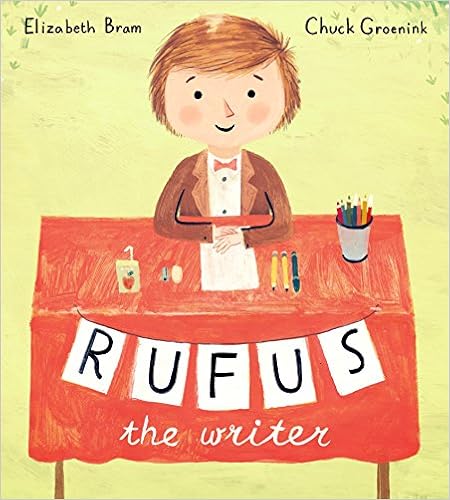
Writing is an important skill for students to learn, but also one of the most challenging.  Writing is difficult for a variety of reasons.  Many students are also reluctant to write.  Without good writing instruction these students will continue to avoid writing. Teaching students about the power of writing is important, as is motivating and encouraging students to write. If students are to realize the power of writing they need to engage in the task.  They need to see themselves as writers.  One way to encourage and inspire writers is to share and discuss stories about writers.  Three picture books that have the potential for inspiring writers are: Ralph Tells a Story by Abby Hanlon, Rufus the Writer by Elizabeth Bram, and Billy’s Booger: A Memoir (Sorta) by William Joyce.


Ralph Tells a Story by Abby Hanlon
In this book, Ralph’s teacher always says that, “Stories are everywhere,” yet Ralph cannot write a story.  Instead he stares at the floor, avoids writing by going to the water fountain, and begs a classmate for help.  Ralph’s difficulties with writing are those that many students can relate to.  The story has a happy ending when Ralph’s classmates help him write a story and he learns that stories really are everywhere.  This is an excellent book to start a discussion about the struggles that writers face and how to work through them.  The endpapers show books that Ralph has written since writing his first story.  They are all related to ordinary, everyday topics (such as "When Milk Came Out of My Nose" and "My Bathroom Emergency") and could inspire students to discover their own stories. 


Rufus the Writer by Elizabeth Bram
Rufus is looking up at the clouds one day when he thinks to himself, “I’m not going to have a lemonade stand this summer.  I’m going to have a story stand.”  Rufus’s friends visit his story stand and he writes them stories.  Pages of the book also show the stories that Rufus has written.  The friends enjoy reading their stories at the end of the book.  This book would be useful to create enthusiasm for writing and inspire students to write stories for others.  Rufus’s stories, which sound like the stories that young students may write themselves, can be a springboard for discussing imagination and creativity.


Billy’s Booger: A Memoir (Sorta) by William Joyce
This is Joyce’s true story about his younger self, Billy, who wrote his first book in fourth grade.  Billy, a student whose creativity often causes him difficulty in school, is described as an odd boy by his teacher.  When the librarian announces a writing contest, Billy writes a unique and imaginative story.  Billy's story, titled, “Billy’s Booger” is featured as a book within the book.  Although Billy is at first disappointed that his story doesn’t win the contest, he is pleased that it becomes a favorite of his classmates.  This is another book to spark students’ creativity and imagination.  It can also lead to discussions about how one’s writing can be appreciated and enjoyed even though it may not be considered a conventional piece of writing.  In addition, it may spark students’ ideas for writing their own memoirs. Students will definitely enjoy the humor in this book.  

These books can begin conversations about students' writing lives and hopefully will provide inspiration for students' own writing.