Pages

Friday, July 13, 2018

Literacy Essentials by Regie Routman, Part II


I have been reading Regie Routman's book, Literacy Essentials: Engagement, Excellence, and Equity for All Learners. The book is divided into three sections: "Engagement", "Excellence", and "Equity." I previously read and wrote a blog post about the first section, "Engagement" here. The second section of the book, "Excellence," is brimming with as much practical and insightful knowledge as the first section.

The idea of teacher excellence is something I have strong beliefs about. I have seen programs come and go in the different school districts I have worked in. Some of these programs were abandoned after only a couple of years. The remains of these programs often get tucked into the back of storage closets, gathering dust, as the components of a new, shinier model take its place. Sometime the materials connected to these programs were never even opened because teachers were unsure how to use them within the program or they were never necessary to begin with. None of these programs have been the quick-fix that it seems many educators, administrators, and other stakeholders seem to be looking for. Unfortunately that quick-fix will never exist because programs won't work for all students all of the time.

Ensuring that there is an excellent teacher in every classroom is a fix, although one that takes a greater investment of time than the implementation of a boxed program. In the first chapter of the "Excellence" section of Literacy Essentials, Routman explains that professional learning must be a priority if the goal is teacher excellence and the high achievement of all students. I wholeheartedly agree with this. Programs don't make excellent teachers. The recipe for excellence includes a commitment to professional learning in which teachers delve into understanding the reading and writing processes, how students learn best, and the best practices for literacy instruction. This recipe also needs to include time for collaboration in which teachers have opportunities to problem solve together, share what works in their classrooms, and discuss ways to improve student learning. Excellent teachers make the difference in students' achievement.

There is much more within the pages of this section of the book, but here are a few of my takeaways about "Excellence."

My Takeaways


  • Ongoing, collaborative professional learning is crucial to ensuring that there are effective teachers in every classroom. Professional learning that involves conversation about shared beliefs related to literacy instruction and empowers teachers to implement best practices based on those beliefs will have long-lasting effects on students' achievement.
  • Let students talk. Learners deepen their knowledge when they engage in conversation. Supporting students as they learn to actively listen and increase their conversational skills will help to make discussions more effective. When teachers talk less and listen more, students have more opportunities to engage in talk themselves.
  • If students are to get better at reading and writing they need to read and write a lot. Share great literature with students and make the connections between reading and writing. Show students that readers can learn about authors' craft by reading and trying out this craft in their own writing.
  • The end goal in teaching readers and writers is independence. When students are allowed to do the authentic work of readers and writers, they build a sense of agency that will support them as they read and write more challenging text over time. Conferring is an opportunity to name students' strengths and provide feedback that will nudge students forward in their reading and writing.
  • Be a teacher who reads and writes. By reading and writing and sharing this with students, teachers model a literate life. Teachers also gain an understanding of the reading and writing processes that students are being asked to engage in. When teachers read what their students read, they become more knowledgeable about children's literature and have more expertise about books they can share with students and can make recommendations for students.
Look for my thoughts about the final section of the book, "Equity," next week.

Tuesday, July 10, 2018

#CyberPD Week Two

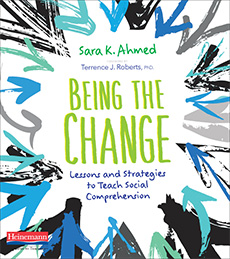
This is week two of #cyberPD, a virtual book study group that I am participating in along with other educators. The group is reading Being the Change: Lessons and Strategies to Teach Social Comprehension by Sara K. Ahmed. You can find out more about #cyberPD here. 

Watching the news or scrolling through my feed on social media, I have no doubts that there is room for our society to change and grow. In fact, change and growth our vital to a better world. We could use more kindness, more compassion, more humanity. Reflection, exploration, and conversation about our world, our place in it, and how we relate to others will help lead to this change. As tough and uncomfortable as this work may seem, it's the work that will propel us forward.

Chapters three and four of Being the Change, offer us tools to reflect, explore, and converse with our students as they consider ideas about the world and their understanding of it. As I read these chapters, I found myself thinking that the conversations the lessons will inspire are the sort that I tend to avoid. I have been guilty of steering the conversation in a different direction when the topic seems to be one that could potentially cause distress or when students bring up questions that are hard to answer. Although discussing bias and supporting students in recognizing bias, the focus of chapter three, can be a heavy topic, it's important to address. Classrooms can be the safe places where students discuss these ideas. Students naturally have questions about the events that are taking place in their lives and the world and the lessons in chapter four can help them make meaning out of what is happening. Even if these questions about the world lead to discomfort, students need the time and space to explore what is happening around them.

As I read the chapters this week, I found myself changing. Rather than avoid the difficult conversations, we can create a safe environment of trust and respect and foster deeper understanding. We can help students make sense of ideas, such as bias, and the events of the world. We can help them figure out the kind of people they want to be and how they want to relate to others. Getting their may take some hard work, some of it risky and uncomfortable, but if we trust in our students and ourselves we can do it. 

Monday, July 9, 2018

It's Monday! What Are You Reading?


It’s Monday! What Are You Reading? is a community of bloggers who link up to share what they are reading. To find out what other bloggers are reading, check out the host blogs: Teach Mentor Texts and Unleashing Readers. You can also follow on Twitter at #imwayr.

What I've Been Reading...


Geraldine by Elizabeth Lilly

Geraldine moves and when she starts at her new school she is the only giraffe. She feels out of place until she meets Cassie, the girl who wears glasses, likes math, and organizes her food. With Cassie's help, Geraldine learns to embrace the qualities that make her who she is. This book would be useful for discussing uniqueness, identity, and self-acceptance. Geraldine has a lot of personality, dramatic, at times, but funny. The illustrations are humorous, as well.

The Truth About Dolphins: Seriously Funny Facts About Your Favorite Animals by Maxwell Eaton III

This book is part of a nonfiction picture book series that combines information with humor. The text provides straightforward facts while the playful illustrations and speech bubbles add a comic element. I have many readers who love to learn about animals and also enjoy books that are silly so I think this is a winning combination. Readers will both learn and laugh while reading this one.

Elephant Secret by Eric Walters

This was an amazing read. Engaging and interesting. It has elephants with personality, a surprising twist, and lots of heart. Read my review of this book that publishes in August here.

Mr. Wolf's Class by Aron Nels Steinke

I am always excited to read new graphic novels because my students love them so much. This one about the first day of school in Mr. Wolf's class is charming and funny. The students, although animals, are true to the life of fourth graders. I wasn't surprised when I read the author's bio to find out he is a teacher himself. This is the first in a series and a definite must-have for my graphic novel collection.

Thursday, July 5, 2018

Elephant Secret by Eric Walters


I got to the last page and wished I could have stayed longer in the elephant sanctuary that is the setting of this book.

Thirteen-year old Samantha Gray lives on a North American elephant sanctuary with her father where they care for a herd of elephants. Samantha has lived with the elephants all her life, understands them better than people, and considers them her family. A baby elephant is born on the sanctuary and, because the mother dies during birth, Samantha takes on the responsibility of tending to her needs. About halfway through the book, the secret of the baby elephant is revealed and from there the story takes an intriguing turn. I enjoyed being totally surprised by the twist in this story, so I will say no more.

This book gives readers insight into the characteristics and behavior of elephants, bringing to light what amazing creatures these animals are. Amused by their personalities and fascinated by their loyalty, I adored the elephants. Samantha is a great character, as well, displaying a selfless love for the elephants and bravery when the lives of the elephants is threatened. Although the elephants are central to the plot, another storyline explored Samantha's relationship with her father and her father's girlfriend, adding another tender element to the story.

A compelling read that imagines a possibility that may be fact in our future, calls attention to the need to protect the wildlife of our planet, and warms the heart. 

I read an advance reading copy of this book, thanks to the publisher, Houghton Mifflin Harcourt Books for Young Readers. This book publishes in August.

Tuesday, July 3, 2018

#CyberPD Week One


For the next few weeks I will be participating in #CyberPD, a virtual book study group. You can find out more about #CyberPD here. I am excited to take part in this community of educators for the third year. This year we are reading and discussing Being the Change: Lessons and Strategies to Teach Social Comprehension by Sara K. Ahmed. I will be posting weekly reflections on the chapters we are reading. Like previous years, I anticipate the #CyberPD community will stretch my thinking and help me grow as a literacy educator.


Week One: Introduction and Chapters One & Two


Teachers make a difference in lives of learners every day. They have an impact on the learners in their classrooms who will then go out into the world and take part in shaping our future. We are social beings and relationships are at the heart of what it means to be an active participant in the world. It is essential that learners have the social comprehension skills to relate to others in a diverse society, one in which perspectives differ, and navigate a world that is fraught with challenges and is always changing. Teachers can make a conscious effort to put these comprehension skills in learners' hands. That is the focus of this book. If we don't teach these skills, can we feel confident that our learners will develop them? Is that a risk we want to take?

Chapter One of the book includes lessons to help learners explore their identities. The goals being to honor learners, build connections, and help learners position themselves as individuals who exist alongside a world of others. Each of the lessons is valuable as students develop a sense of self and respect for those around them. One of the lessons, "Placing Ourselves in the World," involves learners in an exploration of their names. This is a lesson that will help students discover something about themselves and learn more about their peers. In addition to the books referenced that could be used to introduce this lesson, I think Alma and How She Got Her Name by Juana Martinez-Neal would be a useful book to explore this concept.  


Chapter Two of the book discusses how to teach students to be active listeners. I know many adults, including myself, at times, who could continue to improve upon their listening skills, so I believe this is something that our learners should be explicitly taught. As with many skills and strategies that we want learners to develop, modeling and noticing and naming what happens when engaged in the skill or strategy can be an effective teaching practice. Teaching listening skills in this way lends authenticity to lessons and will help learners internalize the behaviors necessary for active listening.  

From my reading of the first two chapters of this book, I am finding the lessons relevant, practical, and engaging. I look forward to next week's reading, Chapters Three and Four. 

Monday, July 2, 2018

It's Monday! What Are You Reading?


It’s Monday! What Are You Reading? is a community of bloggers who link up to share what they are reading. To find out what other bloggers are reading, check out the host blogs: Teach Mentor Texts and Unleashing Readers. You can also follow on Twitter at #imwayr.

What I've Been Reading...


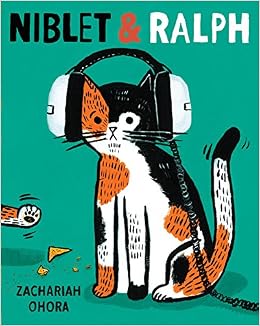
Niblet and Ralph by Zachariah OHora

Niblet and Ralph live in the same apartment building. They find a way to visit each other's apartments, but this leads to confusion when their owners return and find that they each have a different cat in place of their own. Niblet and Ralph are two amusing cats whose mischief inadvertently leads to a new friendship.

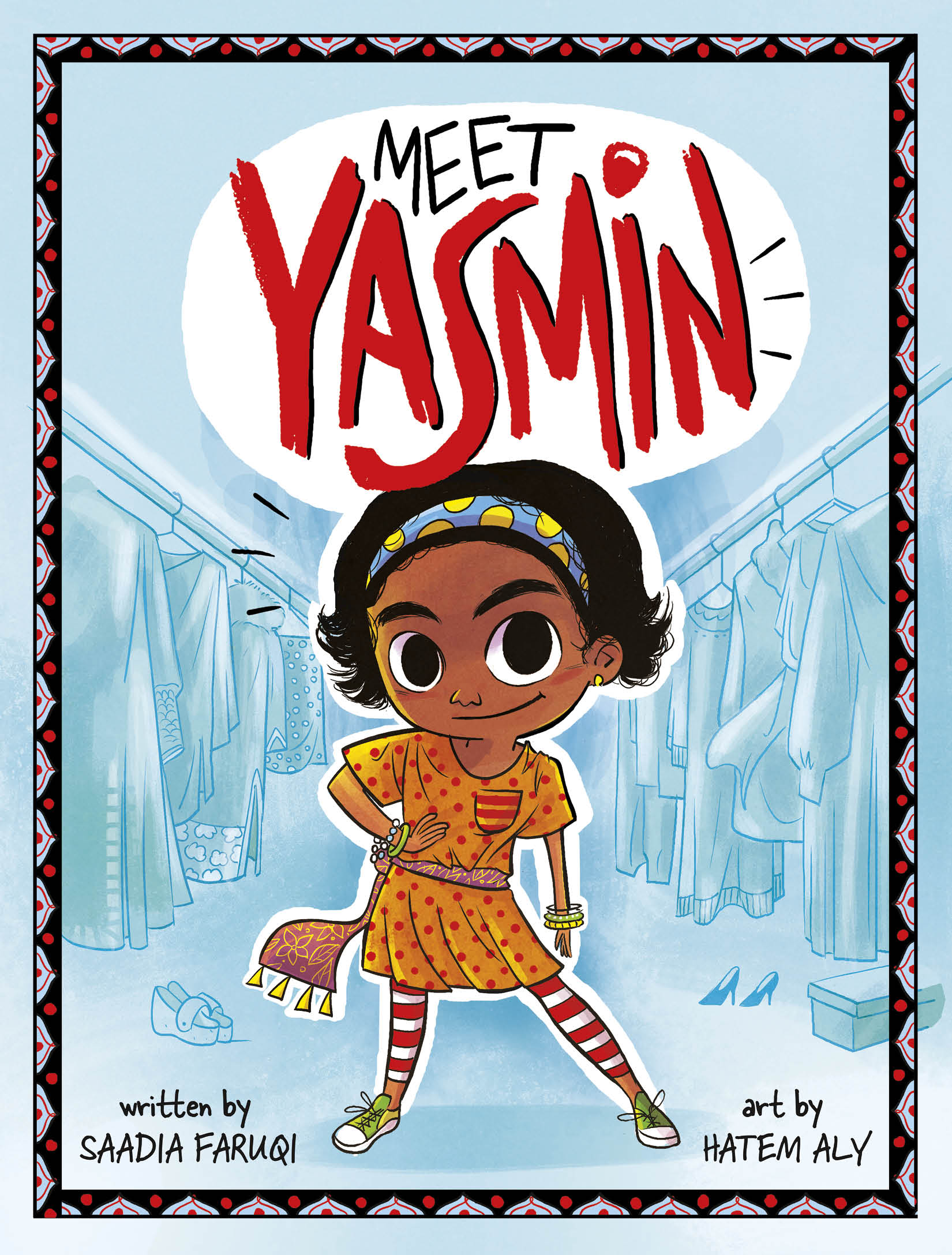
Meet Yasmin! by Saadia Faruqi

Yasmin is a second grader who is great at solving problems. In each of the four short chapters, Yasmin is faced with different problems that are resolved due to her sense of adventure and creativity. Readers will also get a sense of Yasmin's Pakistani-American culture throughout the book. Illustrations, which are on included on most of the pages, are wonderful, too. This will be a great read to recommend to transitional chapter book readers. Thanks to the publisher, Capstone, for sending my book review group, #BookExcursion, an advance reader's copy of the book. The book publishes in August.

Evangeline of the Bayou by Jan Eldredge

Evangeline is an apprentice to her grandmother who is a haunt huntress. When they take a job in New Orleans, Evangeline begins to question whether she has inherited any of the powers that are part of her family's history. In spite of her doubts, Evangeline is determined to keep those around her safe. This is an adventurous read with lots of action and supernatural elements. The setting, the Louisiana Bayou and New Orleans, is both charming and spooky. Evangeline is a character with strength, grit, and spunk and a heroine who demonstrates that fear can be faced head on.

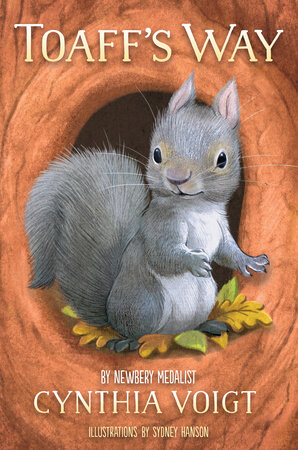
Toaff's Way by Cynthia Voigt

Toaff is an adventurous and curious squirrel who gets separated from his family after a storm. The year following his loss, he takes a journey in which he strives to figure out the world and his place in it. He learns about survival, acceptance, and friendship. Imagining the world from the perspective of a squirrel, this is a sweet and entertaining tale. Toaff will win over readers' hearts. Thanks to NetGalley, I read a digital advance reader's copy of the book. The book publishes in August.

Professional Read


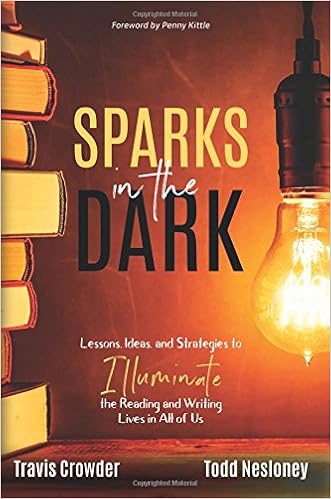
Sparks in the Dark: Lessons, Ideas, and Strategies to Illuminate the Reading and Writing Lives in All of Us by Travis Crowder and Todd Nesloney

Sparks in the Dark is about creating meaningful and authentic experiences for learners so they develop the love of reading and writing that will allow them to grow their literate lives. Throughout the book, Travis, a seventh-grade teacher, and Todd, a school principal, weave stories of their experiences as educators who promote literacy and provide instruction that aligns with best practice. They write about the necessity of access to books, providing choice, being teachers who read and write and the importance of having difficult conversations with kids and being professionals who learn in a variety of ways to improve our practice. This is a conversational, inspirational, and practical professional read. 

Sunday, July 1, 2018

Literacy Essentials by Regie Routman, Part I


Regie Routman is one of those literacy experts I know I can trust. When she has a new book hitting the shelves, I can almost guarantee that it will be brimming with wisdom and practical suggestions. Regie Routman's latest book, Literacy Essentials: Engagement, Excellence, and Equity for All Learners does not disappoint. The almost 400-page book (not including the appendix) is filled with brilliance about teaching and literacy instruction. In the book, Regie explores ideas, research, and practical steps that center on creating a learning environment in which all students can thrive and feel empowered.

When I started reading this book in the spring, I immediately enjoyed and connected to Regie's perspective which is smart and sensible. I found myself starring many of her suggested action steps in order to remember which ones I want to set as goals for myself. I am delving into the book again because I am discussing it with a virtual book club community. During the first week of the book club, we read and discussed the section title, "Engagement". Here are some of my takeaways from this first part of the book.

My Takeaways


  • If we want our schools to be places where all students thrive as literacy learners, we have to engage both, the heart and mind. We reach students' hearts by creating spaces where they feel safe, joyful, and celebrated. We reach students' minds by providing purposeful, relevant, and engaging instruction. Students are empowered when they learn, but also when they have a love for learning.
  • Students achieve more when they are involved in instruction that is authentic and meaningful. Allowing students choice, providing authentic audiences, helping students understand the purpose of their learning and make connections, and giving students opportunities to have a voice in their learning optimizes instruction for all students. 
  • A thriving school culture is one in which there are positive relationships not just between teachers and students, but between the entire school community. Schools should be welcoming places for students, as well as their families. In order to create a positive environment for students, teachers also need to feel safe, trusted, and respected. Students are at the center of the school community, but their sense of well-being and their knowledge that they are cared for depends on an entire school community that is working as a team towards a common goal, the success of its literacy learners. 
Next week, I will post my thoughts about the next section of the book, "Excellence". If you are interested in participating in the virtual book club, which will continue through the week of July 15th, join the Literacy Book Club Facebook page.